JPE: SUBJECT CATEGORY
- Psychology
- Education
- Health and Medical Sciences
- Life Sciences and Neuroscience
- Social and Organizational Applications
- Philosophy and Interdisciplinary Foundations

About the Journal
Journal of Psychology & Education is dedicated to providing a professional platform for researchers, educators, and scholars in psychology and education to publish original research findings, exchange innovative ideas, and share practical teaching experiences and academic insights.
The journal places special emphasis on promoting high-quality development in these fields and actively advancing teaching reform and educational innovation.
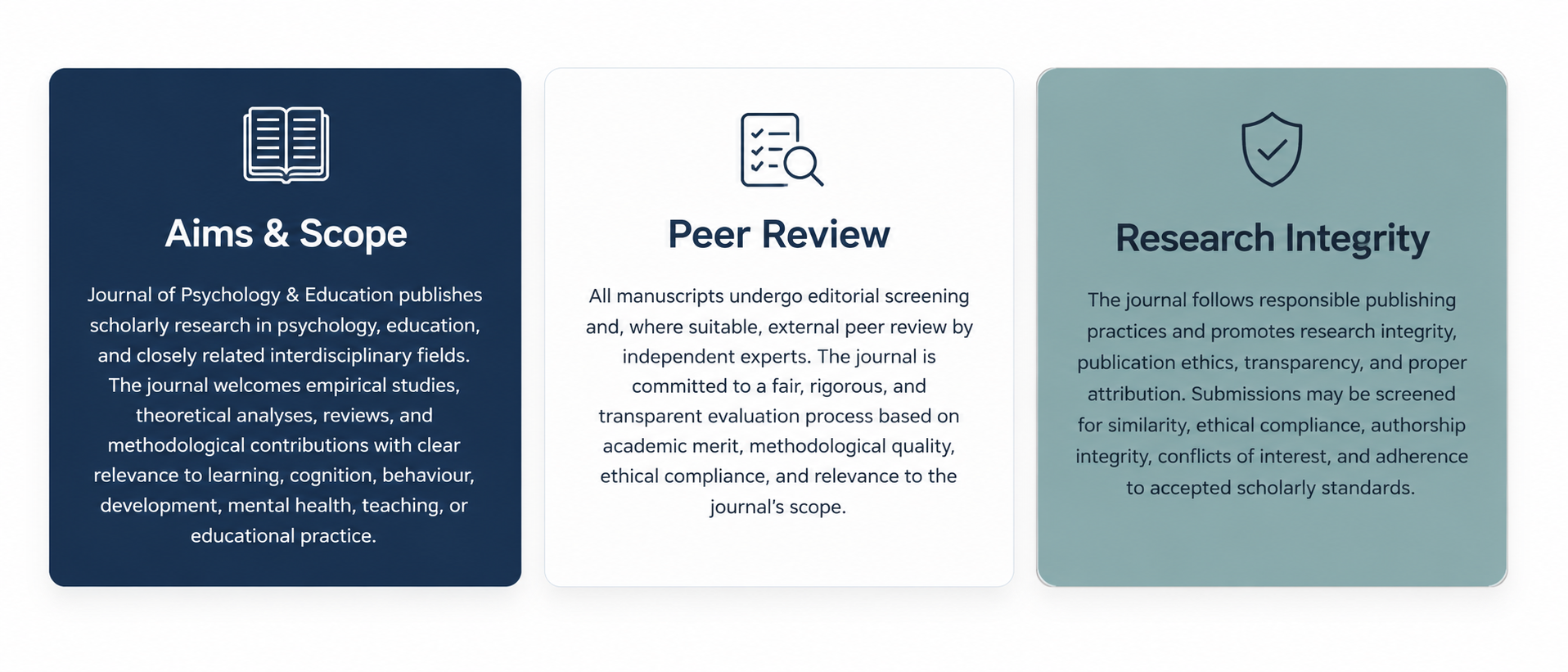
All submissions are subject to a double-blind peer-review process. The journal publishes only original academic papers, and each manuscript undergoes rigorous peer review to ensure it meets high standards of originality, timeliness, academic relevance, and readability.
We welcome both theoretical and empirical studies. Theoretical research should offer original contributions in conceptual motivation, theoretical construction, or analytical frameworks, while empirical work must be grounded in a clear theoretical foundation and designed to be replicable.
This issue of Journal of Psychology & Education presents five articles that examine student development, educational transformation, behavioral addiction, vocational education ethics, and the role of generative artificial intelligence in learning. Together, the contributions highlight the need to understand education not only as knowledge transmission or technological adoption, but also as a field of psychological support, ethical judgment, institutional responsibility, and student agency formation.